Timeline (1956-1970)
June 29, 1956 - Interstate highway system begins with the signing of the Federal-Aid Highway Act.
The interstate highway would be 41,000 miles system of defense highways aiming to eliminate unsafe roads as well as traffic jams. The amount of aid allocated to the construction was $26 billion. The funds were derived 90% from the federal government. In order to raise the funds the Federal Government increased the gasoline tax from 2 cents a gallon to 3 cents a gallon. The interstate highway system would enable quick ad efficient travel for business. The interstate highway would also assist leisure travelers in their trips to destinations such as Disneyland and the National Park.
September 25, 1956 - The first transatlantic telephone cable began operation.
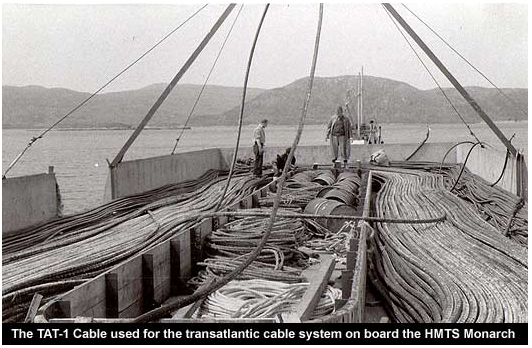
The first submarine transatlantic telephone cable system was considered a milestone. The TAT-1 was a great technological achievement providing unparalleled reliability with fragile components in hostile environments. The cable began at the eastern terminal of the transatlantic and stretched west t Clarenville, Newfoundland. The project was made possible through the efforts of engineers at AT&T Bell Laboratories and British Post Office. The TAT-1 system operated until 1978. Many of the basic concepts and processes developed for achieving highly reliable submarine infrastructure have not changed significantly from those used in TAT-1.
October 8, 1956 - Dan Larsen pitches the first no-hitter, a perfect game, in post-season baseball history
A great moment in Baseball history, a perfect game in the world series. Unprecedented result and the first of its kind in the Americans favorite pastime. The game was Brooklyn Dodgers vs New York Yankees and the final score was 2-0 Yankees. After the end of the world series, Larsen earned about $35,000 in endorsements and appearances.Larsen is still a symbol of success and a example to pitchers to this day.
December 6, 1957 - The first attempt by the United States to launch a satellite into space fails
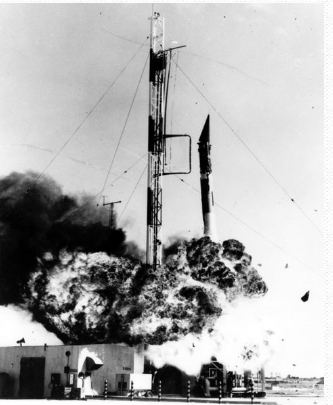
USA's first attempt to launch a satellite into space failed miserably ending in an explosion. The Naval Research Laboratory's Vanguard TV3 was a small satellite designed to test the launch capabilities of the Three-stage vanguard rocket. The satellite was also going to study the effects of the environment on a satellite and its systems in Earth's orbit. Another use for the satellite was to obtain geodetic measurements through orbit analysis. Failure was due to the malfunctioning thrust which caused it to fall back to the launch pad which then ruptured the fuel tanks causing the explosion. No further information was discloused in regards to the mechanical issues that caused the explosion.
December 10, 1958 - Jet airline passenger service is inaugurated in the United States

National leased Boeing 707 jets from Pan American World Airways become the first domestic operator jets in the United States. The Boeing 707 jets were also the first domestic jet service in the USA. The daily flights would be servicing New York to Miami. The distance between New York and Miami was 1, 100 miles. The expected travel time of the flight was 2 hours and 15 minutes. The cost of the monthly lease payment was estimated to be $216,000 per month for operation and maintenance cost.
January 3, 1959 - Alaska is admitted to the United States as the 49th state
The United States flag gets another star. Alaska becomes the 49th state of the United States of America. Alaska is also now the largest state in the Union. The USA President Eisenhower made the special proclamation and signed the deal. The official purchase was made on March 30, 1967 by the Secretary of State William H. Seward from the Russians. The bargain price was only $7.2 million dollars.
April 9, 1959 - NASA selects the first seven military pilots to become the Mercury Seven
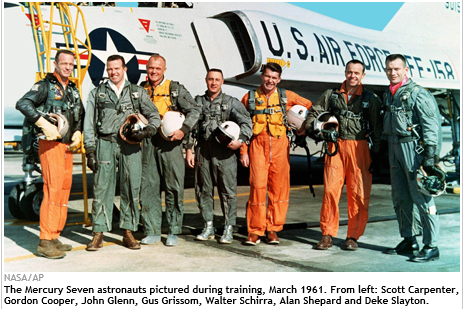
Mercury's Seven are officially the first astronauts of the United States. The main purpose of the Mercury's seven was to launch the country's space program. The small group was selected from 32 candidates. The seven men were all military test pilots. The astronauts became celebrities as the excitement spread in the media. The group had to endure various tortures that tested their tolerance of physical and psychological stress.
September 26, 1959 - President Dwight D. Eisenhower hosts Soviet premier Nikita Khrushchev at his farm in Gettysburg.
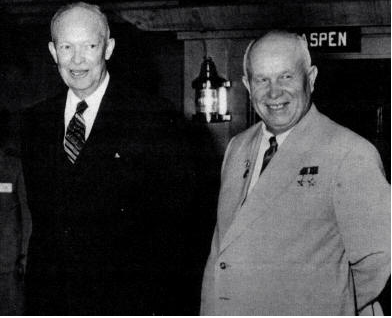
The event where two former "enemies" unite for a polite visit is quite uncommon. The visit to the Gettysburg farm was an unplanned change to a two week tour of the U.S. that had begun in Wall Street, New York. The two leaders arrived at the farm after a brief helicopter flight. Khrushchev loved anything to do with agriculture and the ambiance of this place transformed him. The hope was that this visit was going to set the tone for a upcoming summit. Events that followed on the summit told a different story.
July 4, 1960 - The fifty star flag of the United States is debuted in Philadelphia
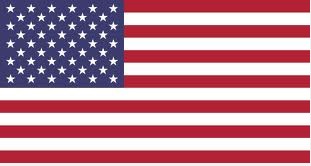
Hawaii's addition to the United States Union becomes official as they get their star on the American Flag. The addition of Hawaii was no easy matter the union had to be approved by congress. After the approval from Congress was attained, the people of Hawaii had to vote to determine the acceptance. The result was a overwhelming 90% acceptance rate. The United States has not had any other unions added to its flag since the final addition of Hawaii. The President Dwight D. Eisenhower was the one who signed the proclamation.
November 8, 1960 - The presidential race to succeed two term president Dwight D. Eisenhower is won by Senator John F. Kennedy
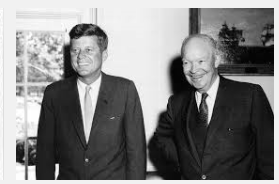
Kennedy was the youngest person elected U.S. President. Kennedy was the first Roman Catholic to serve in the office. President Kennedy won the elections by the minimal difference of 0.1%. Kennedy's and Nixon debates were the first televised presidential debates. Kennedy was endorsed by Martin Luther King. Kennedy earned the support of the African American community.
